Nugget #68 ~ Diversity Isn’t Just Nice. It’s Non-Negotiable.
Oct 23, 2025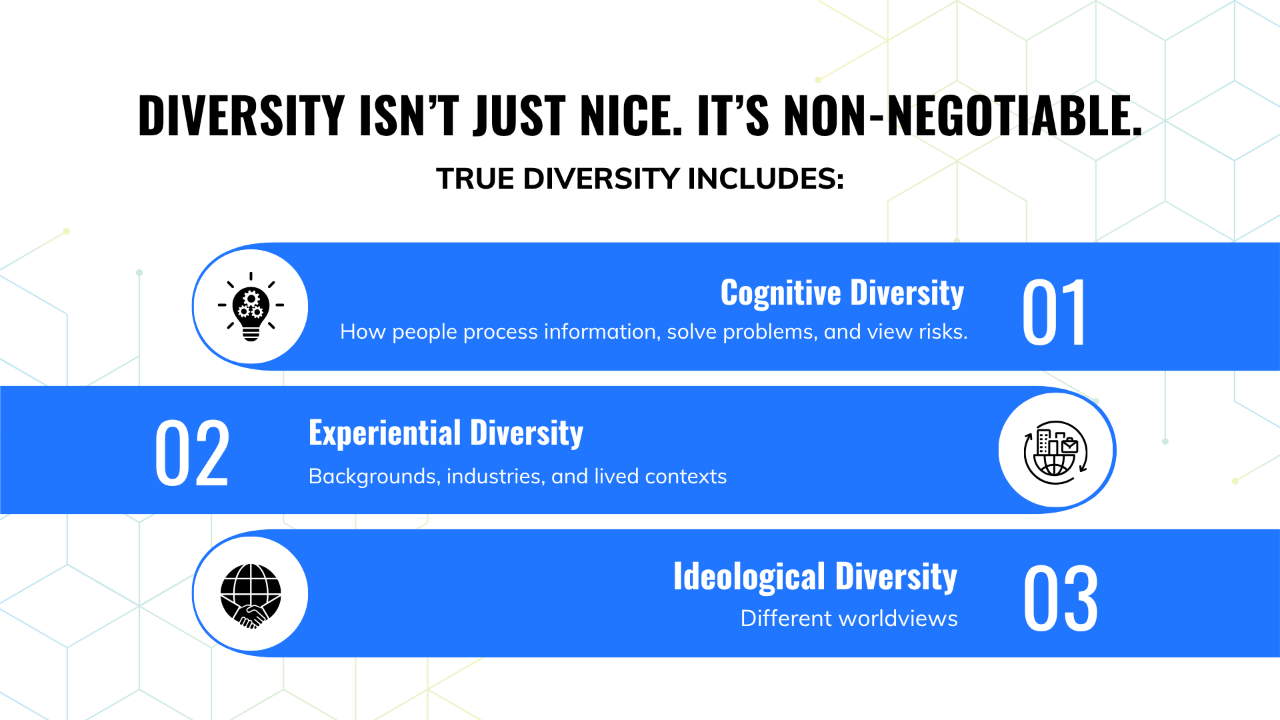
You can’t build a symphony with only clarinets. You can’t explore a jungle with only botanists. And you certainly can’t innovate or adapt in the real world by surrounding yourself with clones of your own thinking or even your own technical discipline.
And yet, many companies - especially those priding themselves on “a coherent culture” - unwittingly build echo chambers. Comfortable, sure. But progress, doesn’t come from nurturing comfort and uniformity.
Let’s be clear. We’re not just talking about demographics. Especially not demographics. True diversity includes:
- Cognitive diversity – how people process information, solve problems, and view risks.
- Experiential diversity – backgrounds, industries, and lived contexts.
- Ideological diversity – different worldviews that might challenge sacred cows.
Homogeneity is efficient - for machines. But humans? Humans thrive at the edge of disagreement.
From workshops in Pretoria to boardrooms in Stuttgart, I’ve seen the magic that unfolds when you put a metallurgist, a financial controller, a logistics maven, an aerodynamicist and an ergonomics designer in the same room - with a whiteboard and a coffee machine.
Confusion first. Then complaint. But eventually… cohesion. And out of that cross-pollination: genuine insight.
It’s tempting to hire people who mirror your own thinking. They get your jokes. They finish your sentences. They use the same acronyms.
But building a resilient organisation means choosing windows over mirrors. People who don’t look like you or think like you. They’re the ones who’ll spot the iceberg while the rest of the crew is singing sea shanties.
And yes, it will often be awkward. But growth is always awkward before it becomes elegant.
In systems engineering, feedback is what keeps systems stable. Diversity introduces rich feedback. It prevents blind spots, detects early signals, and even opens up new opportunity space. a system fed by varied inputs can flex, absorb, and even learn.
Smart Questions to think about:
Prompt 1: Which voices are missing from your decision-making process - and what blind spots does that create?
Prompt 2: Are your current structures optimised for conformity, or for challenge, friction, and growth?